📘 Uso
Los quantifiers son palabras que van antes de un sustantivo para indicar cantidad. En español serían equivalentes a: algo de, mucho, muchos, poco, pocos, nada, etc.
El problema con los quantifiers en inglés es que no todos funcionan igual: algunos van con sustantivos contables (cosas que puedes contar: apples, students, cars), y otros van con sustantivos incontables (cosas que no puedes contar de forma individual: water, money, information).
✨ Visual Summary
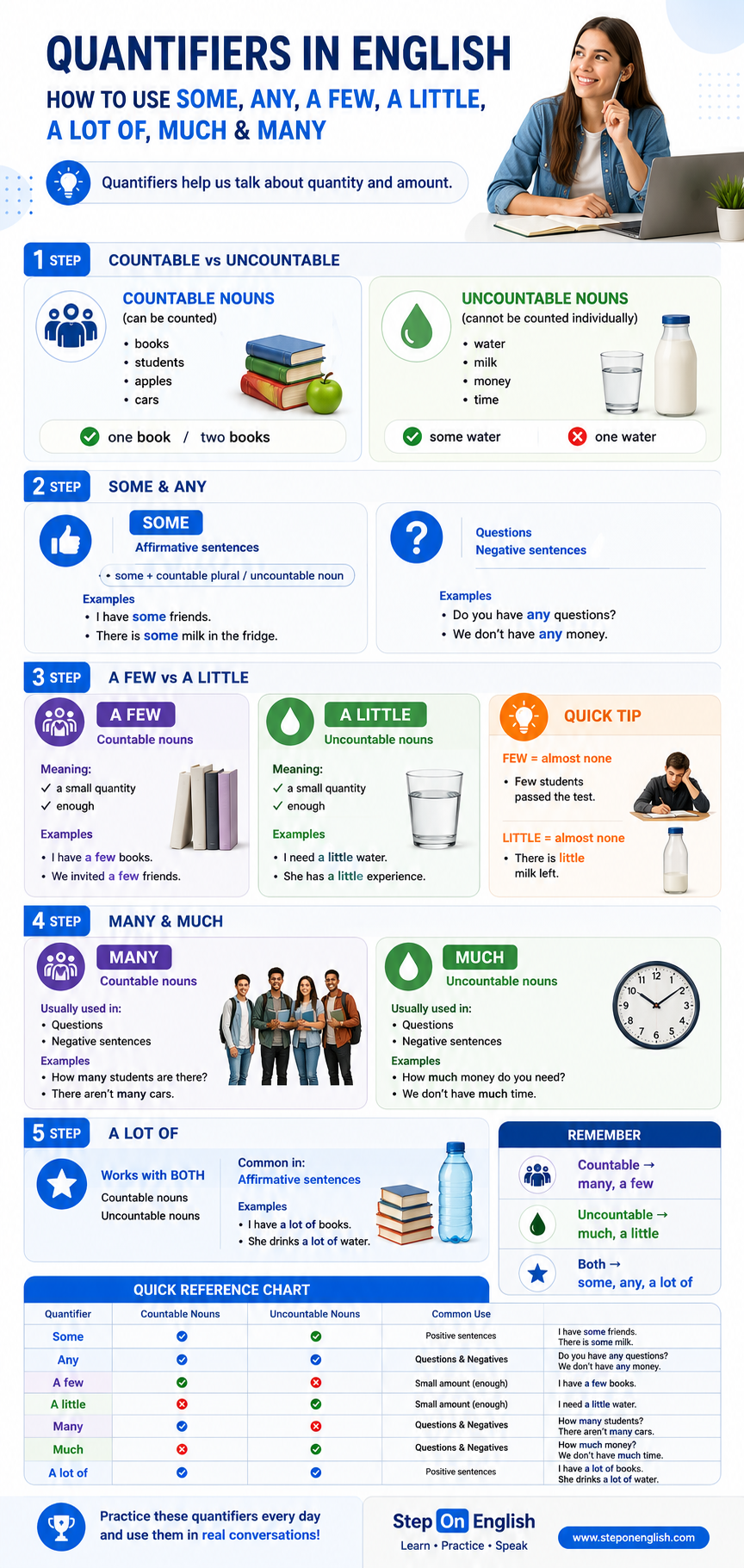
📊 Visual summary generated with AI and reviewed by Step On English.
💡 Antes de usar un quantifier, hazte esta pregunta:
¿El sustantivo se puede contar? ¿Puedo decir one, two, three… de esto?
Si la respuesta es sí, entonces es contable (countable); si la respuesta es no, entonces es incontable (uncountable)
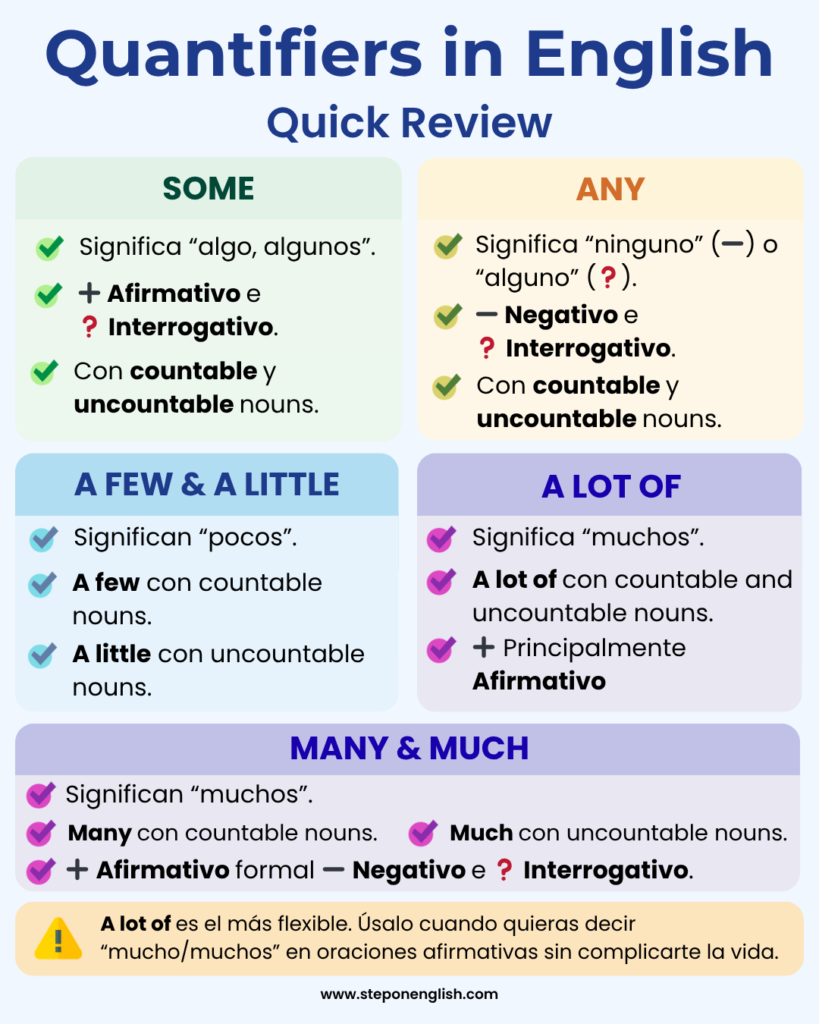
Some
Significa “algo, algunos, algunas”.
Se usa en oraciones afirmativas y en preguntas cuando se ofrece o pide algo cortésmente.
Sirve tanto para sustantivos contables como incontables.
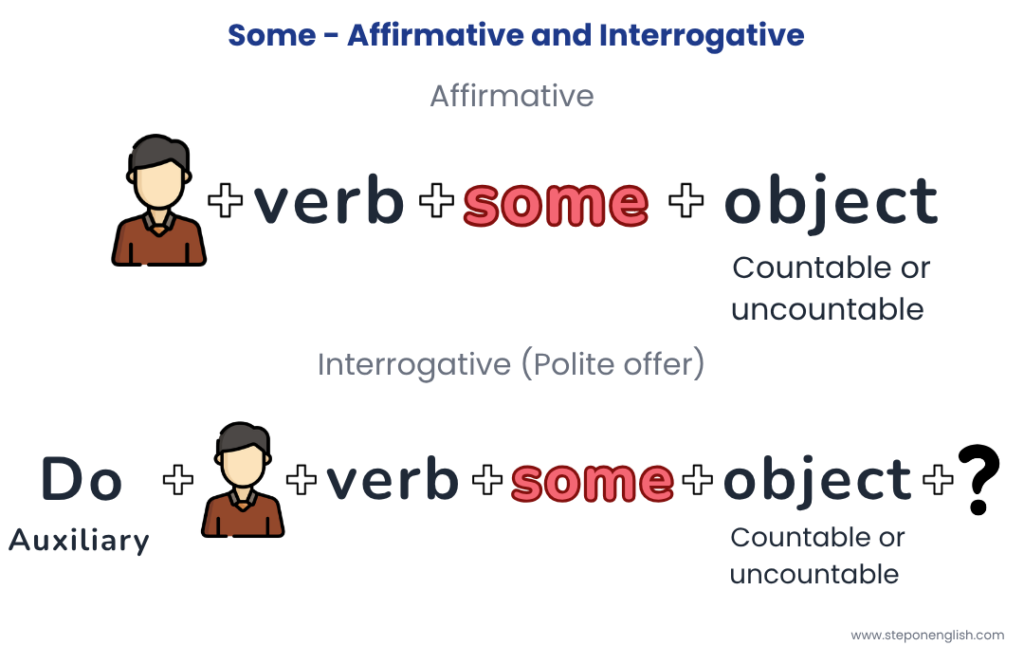
✨ Examples
I have some money.
There are some eggs in the fridge.
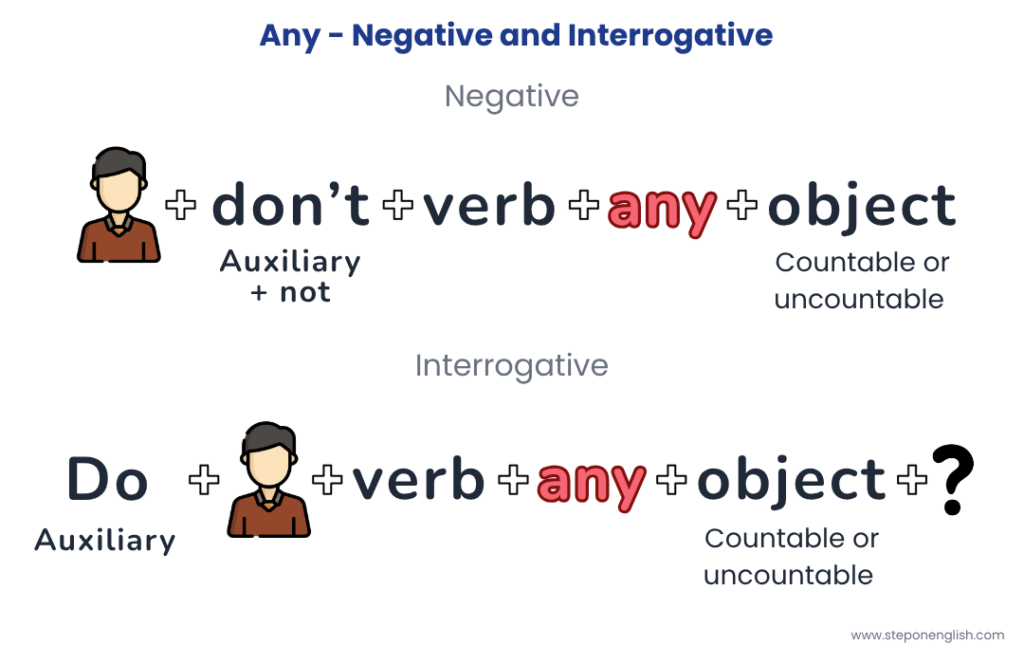
Any
➖ En oraciones negativas
Significa “ningún, ninguna”.
Sirve tanto para sustantivos contables e incontables.
✨ Examples
I don’t have any money.
There aren’t any eggs.
❓ En oraciones interrogativas
Significa “algún, alguna”.
Se usa con sustantivos contables e incontables.
✨ Examples
Do you have any questions?
Is there any milk?
⚠️ Common Errors
Confundir some y any en preguntas.
Do you want any help? ❌ (suena frío o indiferente)
Do you want some help? ✅ (suena natural y amable)
Usas some en preguntas cuando ofreces o pides algo amablemente:
Would you like some coffee? (oferta)
Can I have some water, please? (petición educada)
Much, Many y A lot of
Estos tres expresan “mucho, muchos”. La diferencia está en el tipo de sustantivo y el tipo de oración.
Much → Para sustantivos incontables en negaciones y preguntas.
Many → Para sustantivos contables en negaciones y preguntas.
A lot of → Sustantivos tanto contables como incontables, principalmente en afirmaciones.
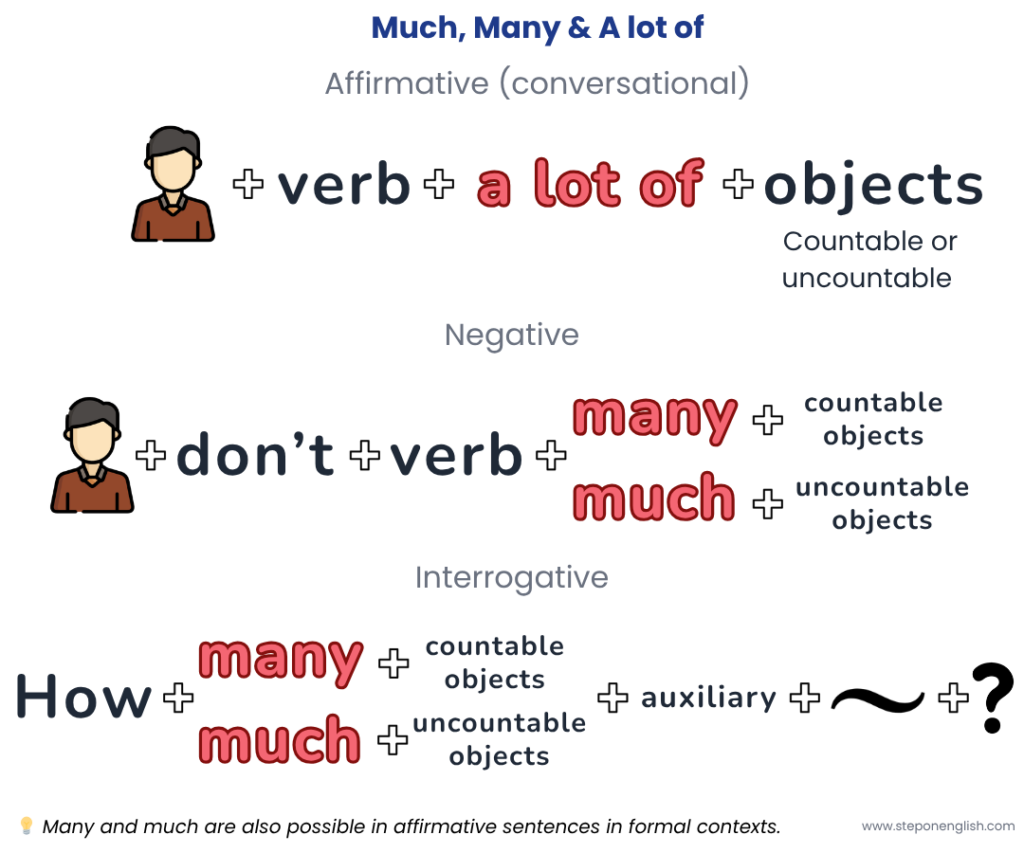
✨ Examples
Affirmative
There are a lot of students in that class.
She has a lot of experience.
Negative
I don’t have many friends in the city.
We don’t have much water left.
Interrogative
How many people are coming?
How much does it cost?
💡 A lot of es el más flexible. Úsalo cuando quieras decir “mucho/muchos” en oraciones afirmativas sin complicarte la vida.
⚠️ Common Errors
Usar much en oraciones afirmativas.
I have much work today. ❌
I have a lot of work today. ✅
Much en oraciones afirmativas suena formal o anticuado. En conversación, usa a lot of.
Usar many con sustantivos incontables.
I don’t have many money. ❌
I don’t have much money. ✅
Money no se puede contar de forma individual, así que necesita much, no many.
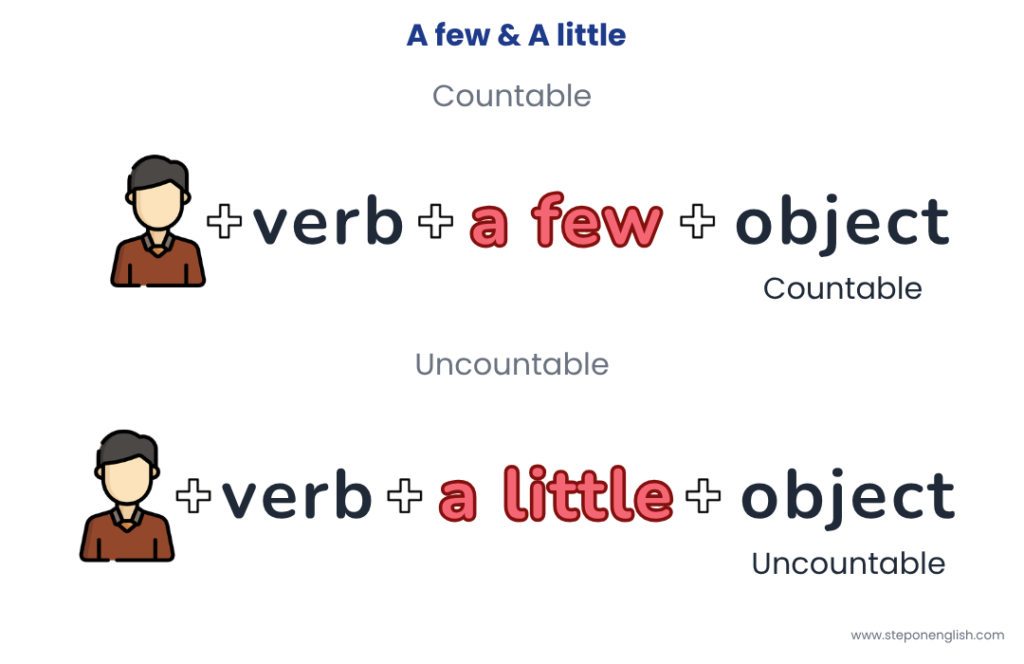
A Few & A Little
Estos expresan “un poco” o “algunos, unos pocos”.
Son afirmativos y positivos en su sentido.
A few → Úsalo con sustantivos contables.
A little → Úsalo con sustantivos incontables.
💡 Ojo con FEW y LITTLE sin artículo:
Few y little sin “a” tienen un sentido más negativo o enfático: casi ninguno, casi nada.
There are few options. (Hay pocas opciones, casi ninguna)
I have little money. (Tengo poco dinero, casi nada)
🧠 Quick Review
💬 The Speaking Lab: Quantifiers in Real Life!
Escucha y repite las siguientes oraciones, pon atención en las respuestas.
📝 Práctica:
Personaliza las preguntas y respuestas con tus ideas y practica con un amigo o compañero.
✔️ Self-Evaluation
Comprueba tus conocimientos.
Quantifiers
Choose the correct option.

Next Step
Sigue aprendiendo a usar many y much, ahora en preguntas en la entrada de cómo usar How many & How much.
🗂️ Recursos recomendados
- 📖 Revisa el tema de How many & How much para ampliar el uso de estos quantifiers.
- 🧠 Aprende más verbos en la Verb Zone.
- 🌐 Usa la lista de verbos en línea.
📚 References
Swan, M. (2014) Practical English Usage, 3rd edition (app edition), Oxford